
logologologo
  • Home
  • Company
    • About Us
    • Global Legal Network
  • Our People
    • Our Lawyers
      • Timothy Wu
      • Sheryl Tan
      • Jerry Loo
    • Key Members
  • Expertise
    • Corporate and Commercial Law
    • Wills, Probates, and Estate Administration
    • Intellectual Property
    • Divorce and Family Law
    • Property and Real Estate
    • Dispute Resolution and Litigation
  • Resources
  • Contact
    • Contact
    • Join Us
  • Home
  • Company
    • About Us
    • Global Legal Network
  • Our People
    • Our Lawyers
      • Timothy Wu
      • Sheryl Tan
      • Jerry Loo
    • Key Members
  • Expertise
    • Corporate and Commercial Law
    • Wills, Probates, and Estate Administration
    • Intellectual Property
    • Divorce and Family Law
    • Property and Real Estate
    • Dispute Resolution and Litigation
  • Resources
  • Contact
    • Contact
    • Join Us
logologologo
  • Home
  • Company
    • About Us
    • Global Legal Network
  • Our People
    • Our Lawyers
      • Timothy Wu
      • Sheryl Tan
      • Jerry Loo
    • Key Members
  • Expertise
    • Corporate and Commercial Law
    • Wills, Probates, and Estate Administration
    • Intellectual Property
    • Divorce and Family Law
    • Property and Real Estate
    • Dispute Resolution and Litigation
  • Resources
  • Contact
    • Contact
    • Join Us
  • Home
  • Company
    • About Us
    • Global Legal Network
  • Our People
    • Our Lawyers
      • Timothy Wu
      • Sheryl Tan
      • Jerry Loo
    • Key Members
  • Expertise
    • Corporate and Commercial Law
    • Wills, Probates, and Estate Administration
    • Intellectual Property
    • Divorce and Family Law
    • Property and Real Estate
    • Dispute Resolution and Litigation
  • Resources
  • Contact
    • Contact
    • Join Us
May 7, 2026 Wills, Probate & Estate Administration

What Are Will Executors Responsible for in Singapore?

If you have been named as an executor in a Will or are in the process of writing one, the practical question is this:

Do you understand what the role requires, and are you prepared to carry it out?

This article sets out what executor responsibilities involve in Singapore, what is commonly misunderstood, and when the process is likely to become more demanding.

What does an Executor Do? 

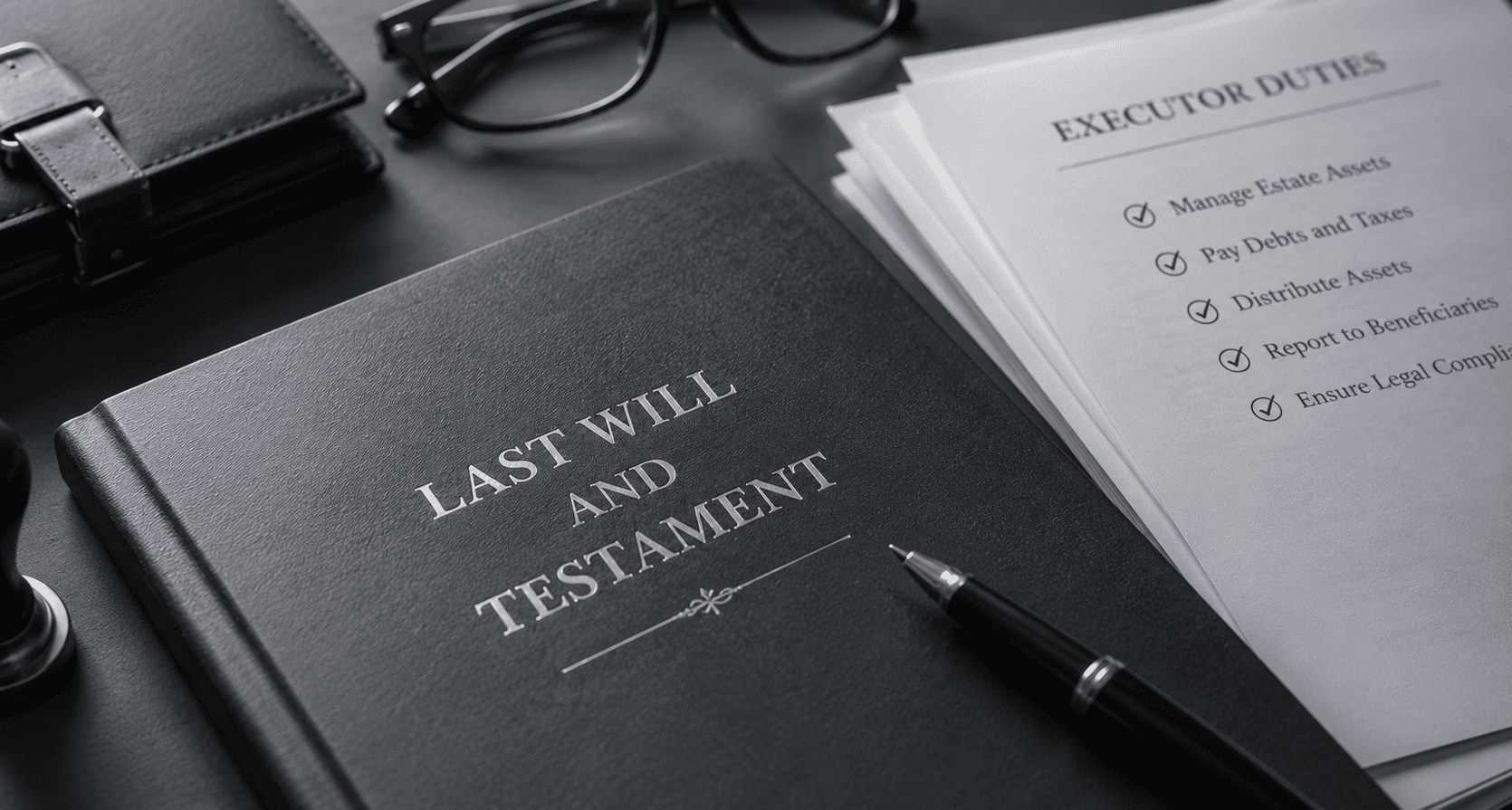
An executor is the person named in a Will to manage and administer the estate after the testator passes away. 

The role is not limited to distributing assets. It begins before any beneficiary receives anything and continues until the estate is fully wound up.

In Singapore, executor responsibilities typically include:

  • Applying for a Grant of Probate from the court
  • Locating the original Will and identifying estate assets
  • Notifying banks, insurers and relevant government agencies
  • Settling outstanding debts, taxes and administrative expenses
  • Distributing the estate in accordance with the Will 
  • Maintaining proper accounts and records throughout

A Grant of Probate is a court order that gives the executor legal authority to deal with the estate. Without it, most financial institutions will not release funds or transfer assets, regardless of what the Will states.

In practice, the role may also involve dealing with banks, insurers, lawyers, agents, and the court. Executors may need to trace information, prepare documents, respond to beneficiaries, and ensure the estate is administered in the correct order. 

Probate applications in Singapore are generally expected to be filed within 6 months from the date of death. Processing typically takes 2 to 3 months, depending on the complexity of the estate.

Common Misunderstandings

The executor’s job starts when assets are distributed 

Distribution is usually the final stage. Before that, the executor must obtain probate, identify and gather assets, verify liabilities, and ensure debts are settled in the correct order. Skipping earlier steps creates risks.

The role is largely administrative or symbolic

An executor is legally responsible throughout the process. Beneficiaries have the right to request accounts. Errors in handling the estate may have personal consequences for the executor.

The family can proceed informally if everyone agrees

Agreement among family members does not replace the legal process. Banks and institutions require a Grant of Probate before releasing funds. Without it, assets remain inaccessible regardless of family consensus.

Every Asset is part of the estate 

Not all assets are under the executor’s control.

Some assets in Singapore pass directly to named individuals without going through the estate, including:

  • CPF monies distributed under a valid CPF nomination
  • Jointly held property that passes by right of survivorship
  • Insurance policies with valid nominations

Part of the executor’s role is to identify which assets form part of the estate, and which do not. This distinction affects the scope of the executor’s responsibilities.

Executor Accountability

The role carries real legal responsibility.

Executors are expected to act in the interests of the estate and its beneficiaries. This includes:

  • Following the terms of the Will
  • Accounting for all beneficiaries, including those who may be difficult to locate
  • Settling debts and liabilities before distributing assets
  • Keeping clear records of every transaction
  • Allowing beneficiaries to inspect estate accounts on request

Executors may face personal liability where estate assets are mishandled, liabilities are overlooked, or distributions are made improperly. This does not mean every delay results in consequences. It does mean the role should be approached with care and in the correct order.

When the Role Becomes More Demanding

Executor responsibilities become significantly more involved when the estate includes:

  • Immovable property (HDB flat, private or commercial property)
  • Multiple bank accounts or investment holdings
  • Business interests or shares in a company
  • Assets held overseas
  • Incomplete or unclear financial records
  • Disputed debts or uncertain liabilities
  • Disagreements among beneficiaries

In these situations, the challenge is rarely a single legal question. It typically involves coordinating multiple steps, parties, and timelines to ensure nothing is handled out of order.

When People Seek Professional Guidance

Guidance is commonly sought during estate administration to ensure the process is carried out properly and in the correct order. This is particularly so where: 

  • The Will contains ambiguous or unclear provisions 
  • The executor is uncertain how to begin the probate process 
  • There are disputes among beneficiaries 
  • There are significant debts or liabilities 
  • Assets are difficult to identify or trace 
  • The estate includes property, business interests, or other complex assets

Even where there are no disputes, executors may still need to deal with procedural requirements, financial institutions, timelines, and legal documentation. Seeking guidance is often less about difficulty alone. It is more about ensuring the estate is administered correctly and efficiently from the outset.

Final Reflection

If you are in the process of writing a Will, choosing an executor deserves careful thought.

The question is not only whether the person is trustworthy. It is also whether they are willing, available, and realistically able to manage what the role requires, particularly if the estate is likely to be complex.

Being named an executor is a practical responsibility, not a ceremonial one.

The role begins at the point of death and continues through probate, asset collection, debt settlement, and final distribution. It involves real accountability and, in more complex estates, significant coordination.

The relevant question when you are writing a Will or have been named in one is not just whether the role is accepted, but whether it can be carried out properly.

How LP Law Can Help 

LP Law Corporation advises on probate applications and estate administration in Singapore. If you are reviewing a Will or have been named as an executor and would like to understand the steps involved, you are welcome to get in touch.

Contact Us
Share
0

Quick Links

  • Home
  • About Us
  • Global Legal Network
  • Our People
  • Expertise
  • Resources
  • Career
  • Contact

Our Services

  • Corporate and Commercial Law
  • Wills, Probates, and Estate Administration
  • Intellectual Property
  • Divorce and Family Law
  • Property and Real Estate
  • Dispute Resolution and Litigation

Head Office

80 Marine Parade Road
#19-06 Parkway Parade
Singapore 449269

Global Network

  • Malaysia Associate
  • Australia Associate

Legal Resources

  • Resources

Privacy Policy  Terms of Use© 2025 LP LAW Corporation. All rights reserved.